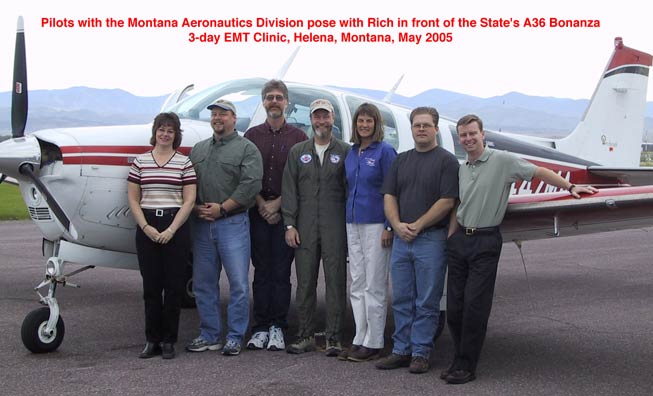
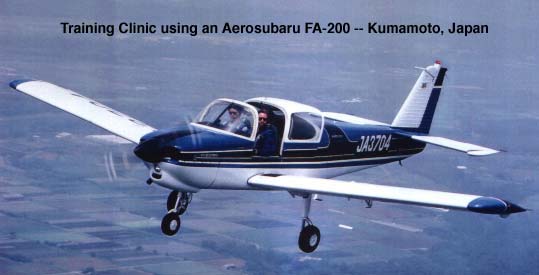
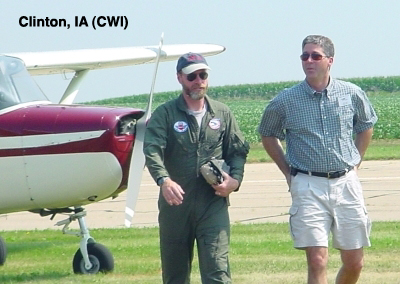
Over the years, Rich has conducted training clinics stretching from Fairbanks, AK to Kissimmee, FL; from Friday Harbor, WA to Long Island, NY; from Bismarck, ND to Olive Branch, MS; from St. Catherines to Sault Ste. Marie, Canada; from Kumamoto to Mt. Fuji, Japan; and from Ardmore to Hawkes Bay, New Zealand.
If you’re interested in having Rich travel to your location to conduct a fun and educational training clinic, the following information should help. Use these guidelines for general planning purposes only; exact cost and other details, however, must be coordinated directly with Rich.
Planning Guidelines
Typical Scheduling Considerations
Although many variations are possible, the following format has worked quite well in the past. Of course, it’s best to plan this event during the most likely time of the year for good weather (and pilot interest). It is also wise to have a back-up airplane just in case, if possible.
It’s important to plan the event far enough in advance not only so that the host can promote it adequately, but also so that all parties involved can coordinate schedules, equipment, FAA seminar notice, and other logistics related to the event. While 90 days is ideally the minimum lead time for promoting such an event, Rich often requires longer notice as his schedule tends to book months in advance.
Weekend Clinic Format
Thursday — Rich arrives on-site, inspects the training aircraft and host facility, and conducts an evening FAA Wings-approved seminar hosted by a local FBO, flying club, or pilot group. This seminar is free and should be open to all pilots whether they are participating in the hands-on training clinic or not. A typical evening seminar runs as follows:
7:00-7:15 — Host Introductions/Announcements
7:15-8:05 — Seminar Topic, Part I
8:05-8:15 — Break
8:15-9:00 — Seminar Topic, Part II
The host can select two of Rich’s 45–50 minute topics to cover Part I and Part II, or one of his 1-1/2 to 2 hour topics for the entire evening. (See Rich’s list of topics)
During the evening seminar, Rich often incorporates video clips along with a Mac laptop running PowerPoint. The FAA can usually provide an LCD projector w/ screen and VCR equipment for this.
Friday thru Sunday — Rich conducts morning and afternoon training sessions each day, typically broken down as follows: Pilots are assigned into morning and afternoon groups. A morning briefing is held for the morning group, followed by consecutive flights, then a lunch period, an afternoon briefing for the afternoon group, and several more flights.
Up to six training sorties are normally flown per day, with a total of (18) slots available for a three-day weekend training clinic. Depending on the airplane and the proximity of the practice area, a “sortie” is usually 45-48 minutes long. A typical training clinic day in the summer might be scheduled as follows:
8:30-9:30 — Morning Briefing, all morning pilots in attendance
9:30-10:30 — Morning Sortie #1
10:30-11:30 — Morning Sortie #2
11:30-12:30 — Morning Sortie #3
12:30-1:30 — Lunch Break
1:30-2:30 — Afternoon Briefing, all afternoon pilots in attendance
2:30-3:30 — Afternoon Sortie #1
3:30-4:30 — Afternoon Sortie #2
4:30-5:30 — Afternoon Sortie #3
Monday — Rich departs unless the demand for training is great enough to justify extending the training portion of the clinic an extra day (this would have to be pre-arranged).
Typical Cost Considerations
Fixed costs
- Round-trip travel expenses
- Accommodations
- Rich’s on-site flat daily rate
- Local costs that may be associated with hosting the clinic
Variable Costs
- The hourly rental rate of the training airplane and accessories.
Amortized Per-Sortie Cost
- For budgeting purposes, the fixed costs are amortized over the number of sorties flown. The sortie operating cost of the airplane must then be added to this amount.
- An on-site training clinic is a value-added service being offered by the host for the convenience of local pilots/clients; advertised thus, pilots traditionally have not balked at the per sortie costs.
It may be possible to find partial sponsorship to offset some of the cost as well, thereby reducing the per-sortie cost for each participant. Perhaps the host facility, or the FAA, or your State Division of Aeronautics, or a local aviation insurance company or fuel provider would be interested in sponsorship.
Other Considerations
Insurance — Rich carries CFI insurance with a $5,000 aircraft damage liability limit.
Promotion/Scheduling — The host shall be responsible for promoting the event locally, scheduling training flights, and coordinating the logistics for an evening safety seminar. Rich Stowell will provide guidance as necessary.